Throwing Rocks at the Google Bus
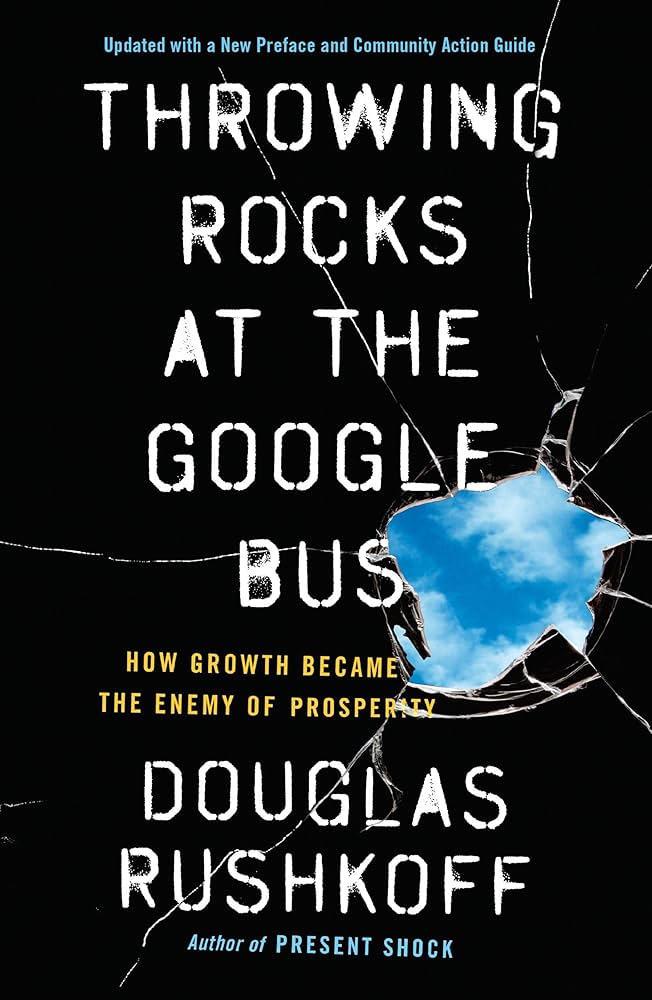
How Growth Became the Enemy of Prosperity
When protesters threw rocks at Google employee shuttles in San Francisco, they were expressing a frustration felt by millions: the sense that the digital economy enriches a tiny few while impoverishing everyone else. But Rushkoff argues that the protesters — and most of their critics — were missing the real problem.
The issue isn't the technology or even the companies. It's the operating system underlying them all: a growth-at-all-costs model of capitalism that was designed in the Renaissance for a very different world. Our digital businesses are running a medieval corporate charter on twenty-first-century hardware, and the results are predictably disastrous.
Rushkoff traces the history of how corporations became programmed to extract value rather than create it — and how the internet, once a potential counterforce, was colonized by the same extractive logic. But he also shows how a growing number of businesses, communities, and platforms are finding ways to generate sustainable prosperity instead.
The result is a book that reframes the debate around inequality and technology — and offers a practical path toward an economy that works for everyone, not just the shareholders.
"We've optimized for growth. But have we lost our way? As an economy? As a community? A challenging and necessary read."— Sherry Turkle, author of Reclaiming Conversation
"Every great advance begins when someone sees that what everyone else takes for granted may not actually be true. Rushkoff questions the deepest assumptions of the modern economy, and blazes a path towards a more human centered world."— Tim O'Reilly, founder of O'Reilly Media